

Global logistics in 2025 are under intense pressure. 76% of European shippers reported major supply chain disruptions, with many facing repeated incidents throughout the year. At the same time, 90% of supply chain operations executives say digital tools have improved their visibility and cost control, highlighting how traditional forwarding models are falling behind.
Yet many forwarding and logistics teams still struggle with the same recurring pain points: scattered systems, slow quoting, manual documentation, poor container visibility, and fragmented communication with partners. These issues lead to rising operational costs, sluggish response times, and frustrated customers.
INTECH steps in to solve exactly these challenges. With deep implementation expertise, INTECH integrates SeaRates ERP as a modern logistics backbone, connecting TMS, WMS, legacy ERPs, and partner systems into a single, real-time environment. SeaRates ERP delivers unified tracking, automated workflows, and transparent collaboration without disrupting existing operations.
This article explains the core pain points traditional logistics teams face today and shows how a structured INTECH-led implementation of SeaRates ERP transforms visibility, speed, and operational efficiency across the supply chain.
Understanding integrated logistics systems in the digital era
Modern supply chains operate across many disconnected systems. Carriers, terminals, customs agencies, warehouses, brokers, and customers all maintain their own platforms, which creates inconsistent data, delayed updates, and limited visibility.
Integration is no longer just about linking systems. It is about building reliable, timely, and standardized information that logistics teams can use to make faster, more accurate decisions.
INTECH follows a results-first integration philosophy. Focusing on the critical 20% of connections and leveraging SeaRates ERP, INTECH aims to achieve 80% of the visibility and automation benefits.
This includes carrier data feeds, booking synchronization, gate event updates, and proof-of-delivery flows. Once the foundation is stable, additional integrations can be added in a controlled, low-risk, iterative way.
Evolution of supply chain integration and ERP connectivity
Supply chain connectivity has advanced significantly. What used to rely on point-to-point EDI links and scheduled file transfers has evolved into a mix of modern and legacy patterns, including:
- Real-time API exchanges and event-driven webhooks
- Live telemetry streams from AIS, IoT, and telematics
- Hybrid workflows where EDI continues to support compliance and long-standing partners
SeaRates ERP supports this blended environment by enabling logistics teams to modernize their digital stack without immediately replacing existing systems. It serves as a flexible integration layer that brings together old and new technologies into a single, dependable operational framework.
Key Components of Modern Logistics Systems
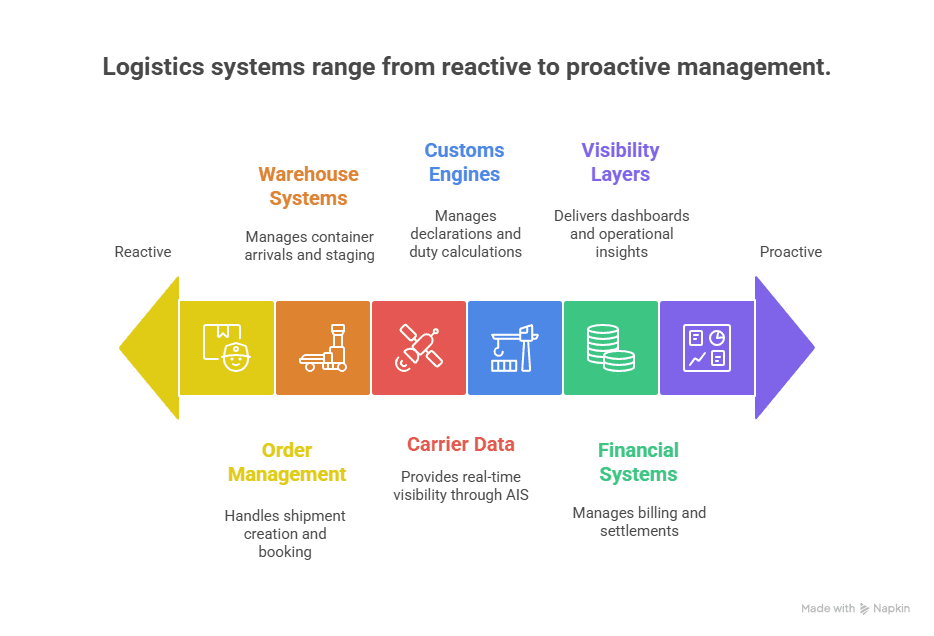
Implementing SeaRates ERP effectively means connecting the core systems that shape daily logistics performance. Modern supply chains rely on several critical components, and a robust integration framework brings them together into a single, reliable information flow.
Here are the areas most commonly linked during a SeaRates ERP deployment:
- Order management and TMS systems that handle shipment creation, rating logic, and booking workflows.
- Warehouse, yard, and gate systems that manage container arrivals, staging activities, and proof-of-delivery events.
- Carrier and port data feeds, including AIS signals, booking confirmations, and gate movement events that inform real-time visibility.
- Customs and compliance engines are responsible for declarations, classification codes, and duty calculations.
- Financial systems that manage billing, claims, and settlements with carriers and partners.
- Visibility and analytics layers that deliver dashboards, alerts, and operational insights for faster decision-making.
INTECH connects these components through a structured integration plan, so SeaRates ERP becomes the central layer that unifies tracking, execution, and communication across the entire logistics network.
Importance of Data Synchronization Across Supply Chain Networks
When systems do not share accurate and timely data, delays become inevitable. Out-of-sync booking updates, incorrect ETAs, or mismatched invoice information lead to missed service commitments, costly chargebacks, and frustrated customers.
SeaRates ERP solves this by acting as the central source of truth, ensuring that every integration follows consistent record standards, verified timestamps, and traceable event history.
Modern supply chains depend on three core synchronization patterns:
- Canonical master data covering customers, equipment, and rate structures.
- Event-driven sync where webhooks push key milestones, such as gate-in, vessel departure, and container arrival.
- Periodic reconciliation using scheduled batch checks to capture any mismatches and maintain system accuracy.
With these patterns in place, logistics teams gain smoother workflows, fewer exceptions, and a dependable operational picture across partners and systems.
The Role of SeaRates ERP in Supply Chain Transformation
SeaRates ERP is designed to enhance the digital foundation of logistics operations. It brings together visibility, automation, and integration capabilities that allow companies to modernize without disrupting their existing setup.
Unique Features of SeaRates ERP
- Multi-carrier ingestion that unifies data from shipping lines, terminals, and ports into clean, standardized shipment events.
- Booking and documentation automation that generates bills of lading, manifests, and shipping instructions with minimal manual input.
- Visibility dashboards that provide real-time maps, exception alerts, and performance tracking.
- Integration-ready APIs that support both push-based workflows through webhooks and pull-based workflows through REST services.
- Hybrid EDI compatibility for partners who still depend on X12 or EDIFACT exchanges.
How to Integrate SeaRates ERP for Freight Forwarding and Shipping Companies
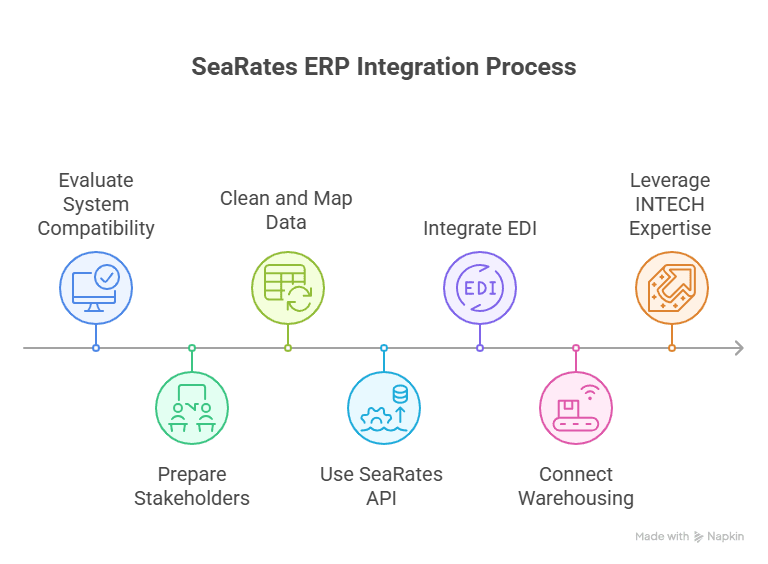
Successful SeaRates ERP integration begins with acknowledging the core challenge: modern logistics teams depend on too many disconnected systems. Freight forwarders, NVOCCs, and shipping companies run TMS, WMS, port systems, email threads, spreadsheets, and carrier portals that rarely speak the same language.
This lack of supply chain integration leads to delayed ETAs, manual firefighting, invoice mismatches, and rising customer service load. INTECH solves this by delivering a structured, outcomes-first framework for SeaRates ERP integration that connects your logistics systems, normalizes data, and creates a unified operational view across your network.
1. Evaluate System Compatibility and ERP Connectivity
Start with a connectivity audit to understand your digital landscape:
- Which systems support modern APIs for real-time connectivity
- Which partners still rely on EDI exchanges
- Which security protocols apply, such as VPN access, IP allowlists, or SFTP channels
INTECH classifies your systems into three groups: real-time-ready, batch-capable, or legacy-only. Each group is then linked to the suitable integration pattern, ensuring SeaRates ERP connects smoothly without disruption or downtime.
2. Prepare Stakeholders and Internal Workflows
Technology alone does not guarantee successful supply chain integration. Operations, IT, finance, and customer support all play a role in how data moves.
INTECH runs a short impact mapping workshop to align:
- Internal data ownership
- SLA expectations
- Inbound and outbound message flows
- Exception management rules
This reduces surprises during rollout and ensures every team understands how SeaRates ERP strengthens daily operations.
3. Clean and Map Data for Reliable Data Synchronization
Poor data creates delays, exceptions, and billing issues. Before going live, INTECH performs a targeted data hygiene sprint:
- Standardize master data such as customer lists, location codes, and service levels
- Remove duplicate accounts, old rate cards, and mismatched fields
- Map all field-level transformations, such as carrier milestone codes to SeaRates canonical status events
This ensures clean, predictable synchronization between SeaRates ERP and your logistics systems.
4. Use the SeaRates API for Custom Workflow Automation
The SeaRates API is the backbone of modern ERP connectivity, enabling automation across booking, tracking, documentation, and invoicing. INTECH follows three best practices for API driven integration:
- Use an event-first architecture and subscribe to shipment lifecycle updates
- Build idempotent receivers so repeated events do not create duplicates.
- Version every API contract for long-term stability
A practical INTECH onboarding approach begins with a read-only integration for two to four weeks, allowing your team to mirror shipment events in a staging dashboard before enabling write-back functionality.
5. Integrate EDI for Partners Still Using Legacy Systems
EDI integration remains necessary for carriers, customs authorities, and legacy supply chain partners. INTECH uses EDI as the compliance channel and SeaRates API as the operational visibility channel:
- Convert EDI messages into SeaRates canonical events
- Use asynchronous acknowledgements to reconcile inbound and outbound EDI
- Maintain audit trails for billing, regulatory, and shipment disputes
This ensures your digital and legacy partners are both supported without slowing your transformation.
6. Connect Warehousing and Material Handling Through SeaRates ERP
For shipping companies and forwarders with warehouse operations, SeaRates ERP connects directly with WMS and yard systems:
- Advance shipment notices and gate events for automated receiving
- Tasks for putting away and dispatch triggered by container activity
- IoT and barcode updates that feed real-time data into SeaRates visibility dashboards
INTECH also configures a manual override circuit that allows operators to intervene when automation requires human judgment.
7. Leverage INTECH Expertise for Fast, Low Risk Adoption
INTECH brings domain knowledge from real-world implementations and deep experience working with freight forwarders and shipping companies that face challenges such as:
- Slow response time due to scattered emails
- Limited visibility that frustrates customers
- Difficulty scaling without adding headcount
- Manual errors that reduce profitability per shipment
With modular deployment, rapid configuration, and continuous support, INTECH ensures SeaRates ERP integration delivers real value fast.
Conclusion
Integrating SeaRates ERP into an existing supply chain is less about replacing systems and more about connecting and harmonizing them. By prioritizing high-impact integrations, enforcing disciplined data hygiene, and combining APIs with EDI where necessary, organizations can unlock real-time visibility, reduce manual work, and improve decision-making.
At INTECH, we follow an iterative integration process where our team first identifies issues in your existing system, stabilizes data and security, runs a pilot with select lanes and partners, and then scales. This pragmatic, Pareto-focused approach ensures you achieve quick wins while developing a resilient, future-ready logistics platform.
Connect with us to run a compatibility audit for your existing TMS/WMS/ERP and produce a prioritized integration roadmap tailored to your network.
FAQs
How long does a typical SeaRates ERP integration take with INTECH?
Most implementations take four to eight weeks, depending on the number of connected systems, data quality, and required workflows. INTECH accelerates delivery by prioritizing high-impact integrations such as tracking, booking sync, and financial workflows.
Can SeaRates ERP integrate with both API based systems and EDI-based partners?
Yes. SeaRates ERP supports real-time API connectivity and full EDI support for partners that still use X12 or EDIFACT. INTECH builds hybrid integration models that enable digital and legacy systems to operate together without disruption.
What improvements can logistics teams expect after integrating SeaRates ERP?
Teams typically see faster response times, fewer manual errors, stronger shipment visibility, and more consistent data synchronization. Many freight forwarders report improved customer satisfaction and more effortless scalability within the first 90 days.
Do we need to replace our existing TMS, WMS, or ERP to implement SeaRates?
No. SeaRates ERP is designed to complement and connect your current systems, not replace them. INTECH maps the best integration routes so your existing tools continue to function while SeaRates adds visibility, automation, and unified tracking.
How does INTECH ensure secure data exchange during supply chain integration?
INTECH uses encrypted transfer channels, VPN and IP allowlists, token-based API authentication, and controlled message gateways. For legacy EDI, INTECH adds an audit and validation layer to ensure all data is synchronized securely and accurately.
