

Freight rates in 2026 will be more than just volatile. They will be structurally different. Nearshoring, fleet transformation, and changing competitive dynamics. It will redefine how goods move, while new vessel capacity and persistent route disruptions keep price swings alive across major trade lanes.
Many shippers still depend on historical rate sheets, email threads, and static spreadsheets that were built for a slower, more predictable market. As a result, they struggle to respond in time to sudden surcharges, blank sailings, or demand spikes, and often see the impact only when budgets are already off track.
AI freight rate management offers a new way forward rather than a choice between intuition-led buying and rigid, rule-based systems. McKinsey’s analysis shows that AI-enabled operations can reduce inventory by 20–30% and cut logistics costs by 5–20%, setting a clear benchmark for what data-driven execution can deliver.
AI-based platforms like SeaRates continuously analyze carrier data, market signals, and lane performance to surface crucial insights and recommend optimal rates and routing options in real time. In this article, you will explore how shifting from manual rate lookup to AI-driven rate intelligence reshapes the way shippers buy freight.
What Changes Can You Expect In Freight Rate Management For 2026?
Freight procurement used to follow predictable cycles. In 2026, that is no longer true. Spot and contract rates can change in a matter of days. Nearshoring, fleet growth, and geopolitical shocks affect capacity and demand.
Analysts predict a 25% fall in global spot ocean rates. Long-term contract rates may drop by about 10%. Rates may spike in specific corridors due to capacity adjustments. Disruptions can cause sudden rate changes.
Relying only on fixed calendars is no longer enough. Shippers now prefer continuous, scenario-based freight planning. AI-powered rate management is key to this change.
- Always-on sourcing cycles that adapt to changing lane conditions
- Automated tendering workflows triggered by thresholds, not calendar dates
- Forward-looking rate signals rather than backward-looking averages
- Transparent, lane-level comparisons that expose hidden margin opportunities
The result is a shift from defensive, reactive buying to an active strategy in which shippers continuously rebalance their freight portfolio around cost, service, and risk.
Common Issues in Modern Freight Forwarding
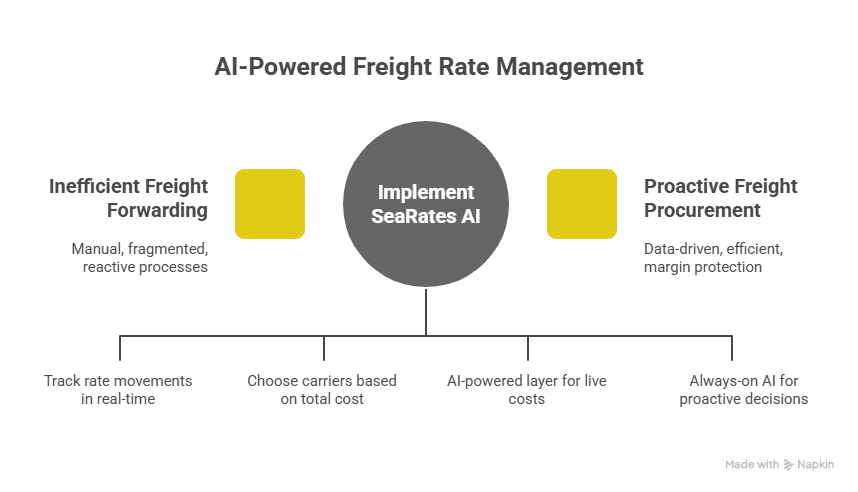
Modern freight forwarding changes quickly. Rates, capacity, and service levels shift overnight. Many teams rely on fragmented tools and manual work. This makes AI freight rate management difficult.
Freight rate volatility and budget gaps
Freight rates change faster than internal processes. Spot changes, surcharges, and corridor swings affect budgets. SeaRates uses AI to monitor market movements continuously. It benchmarks contract and spot rates. It finds real-time cost-saving strategies. Shippers avoid surprises and save up to 15%.
Complexity in carrier and lane selection
SeaRates helps choose carriers based on total cost. It considers transit time and reliability. It uses freight rate analytics and AI. Manual PDF and email comparisons are no longer needed.
Fragmented rate data and limited visibility
Surcharges, free-time rules, GRIs, and accessorials are scattered. SeaRates consolidates this data into one AI-powered layer. It shows live shipment costs and helps save money.
Slow and reactive decision-making
Traditional forwarding relies on batch schedules and tenders. It also uses quarterly reviews and spot buying when needed. SeaRates always uses always-on AI for dynamic pricing and freight rates. It automatically triggers re-tenders, re-bookings, or alternative routes.
This happens when conditions change. Shippers move from reacting to proactive, data-driven freight procurement. This approach consistently protects margins.
The Role of AI in Revolutionizing Freight Procurement
AI freight rate management is changing freight procurement. Instead of static spreadsheets, manual tenders, and gut-feel decisions, shippers now use AI. AI adds intelligence, speed, and automation at every stage of sourcing, negotiation, and awarding.
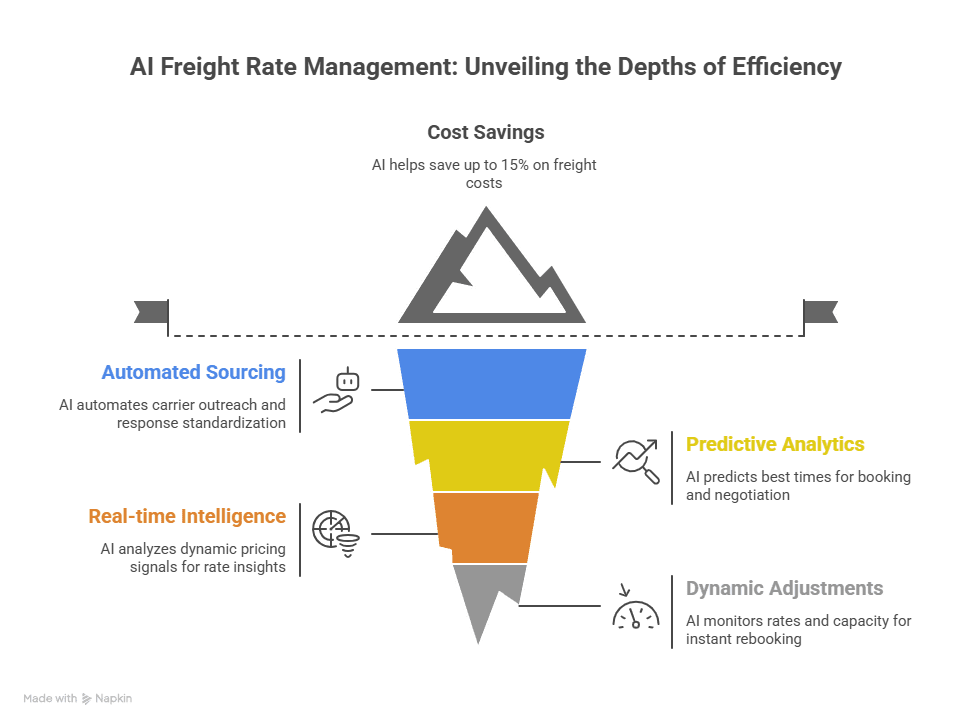
SeaRates leads this shift. It uses AI-powered rate management to help customers save up to 15% on freight costs. This is done through smarter shipping cost optimization and freight rate intelligence.
Streamlining sourcing and tendering with AI
Traditional RFQs and tenders involve many emails, manual data entry, and hours of comparison. AI-driven freight procurement on SeaRates automates carrier outreach, standardizes responses, and ranks offers based on cost, transit time, reliability, and carrier history. This simplifies the process into a guided, data-driven workflow that finds the best options.
Predictive analytics for smarter negotiation
Price discussions often happen too late or at the wrong points in the cycle. By using predictive analytics on market indices, seasonality, and past lane behavior, AI models in SeaRates help find the best times to book, hold, or renegotiate.
Shippers move from reactive haggling to proactive cost-saving, using rate analytics to approach negotiations with a clear view of fair market value and price trends.
Dynamic pricing and real-time rate intelligence
Dynamic pricing has become standard across ocean, air, and land transportation. However, most teams still view rates as static snapshots. SeaRates leverages AI to analyze dynamic pricing signals from carriers and spot markets, providing real-time freight rate insights rather than single quotes.
Shippers can compare current rates with recent trends and understand their implications for optimizing shipping costs on specific routes.
AI-enabled real-time rate adjustments
SeaRates continuously monitors carrier feeds, surcharges, and spot rates, updating recommended options as soon as rates change or capacity opens.
When a superior opportunity arises, AI identifies alternative routings or carriers. This allows teams to rebook or adjust allocations in minutes rather than days, thereby supporting ongoing freight procurement.
Benefits for shippers using AI-powered rate management
AI-driven rate management in SeaRates translates into tangible outcomes for shippers:
- Stronger negotiation leverage based on objective, lane-level benchmarks, and shipping rate analytics
- Faster decision cycles, with automated shortlists and guided recommendations at the moment of booking
- Reduced rate variability through smarter timing, diversified carrier mix, and ongoing optimization
- More accurate budget planning as live data replaces outdated averages in forecasts and reports
- Better alignment between cost and performance, ensuring savings do not come at the expense of service quality
Essential Features of AI-Powered Freight Management Tools
AI-powered freight tools do more than store rate sheets; they turn data into usable freight rate insights. SeaRates integrates these features, enabling shippers to shift from reactive rate searches to proactive, analytics-based shipping cost optimization.
Advanced shipping rate analytics and dashboards
SeaRates offers advanced shipping rate analytics that provide insights into patterns, cost drivers, and hidden margin opportunities across various lanes and modes, surpassing basic rate views. Interactive dashboards compile contract and spot rates, surcharges, free-time rules, and accessorials.
It enables users to promptly identify lanes exceeding budgets, areas of underperformance in freight procurement, and potential savings.
Real-time freight rate intelligence
Contemporary markets demand more than mere quarterly benchmarks. SeaRates offers real-time freight rate insights by integrating live carrier feeds, market indices, and congestion data, enabling users to evaluate current prices against recent trends.
Shippers gain immediate visibility into price fluctuations, capacity variations, and carrier performance, enabling dynamic pricing adjustments and expediting data-informed decisions.
Integrated tendering and scenario modeling
Effective AI freight rate management also depends on seamless integration with sourcing workflows. SeaRates enables digital RFQs, automated carrier outreach, and side-by-side response comparisons.
Scenario modeling enables teams to explore “what-if” options, such as reallocating volume across different ports, modes, or carriers, before committing. This approach transforms freight procurement into an ongoing, optimization-driven process instead of a one-time annual event.
How SeaRates Helps Cut Freight Costs by 15%?
AI-powered rate management is becoming vital in a market with volatile rates and increasing logistics costs. Shippers need real-time freight rate insights and automated purchasing to stay competitive.
SeaRates provides an AI-driven platform that combines sophisticated shipping rate analysis and automation, helping customers save up to 15% on freight expenses.
Companies use SeaRates to simplify procurement, compare contracts with spot rates, and automate rate comparisons, saving time and reducing manual work.
By quickly assessing thousands of options based on cost, transit time, and reliability, the platform recommends the best choice for each shipment. Those who adopt this model gain a competitive advantage in shipping cost optimization, whereas relying on manual processes results in higher costs and slower responses to market changes.
SeaRates combines automation, analytics, and procurement intelligence to deliver measurable savings:
- Automated rate comparison and selection across carriers, lanes, and modes
- Real-time alerts when better rates or alternative routings become available
- Continuous optimization rather than one-off annual tenders
FAQs
How does AI-powered rate management reduce freight costs?
AI ingests real-time carrier rates, historical lane performance, and market signals to identify fair price ranges and spot overpriced options. By recommending the best routing and carrier mix at the time of booking, SeaRates helps shippers avoid rate spikes, capture low-cost windows, and keep freight aligned with budget targets.
Can AI analyze both ocean and air freight rates?
Yes. SeaRates evaluates ocean, air, road, and rail rates in a unified dashboard, enabling true cross-modal optimization. Teams can compare end-to-end cost and transit time across modes, then let the AI engine propose the most efficient and economical combination for each shipment.
What best practices ensure success when implementing AI for freight management?
Success starts with clean, well-structured rate and shipment data, along with strong integration into ERP, TMS, or existing booking systems. A phased onboarding plan with clear lane priorities, user training, and KPI tracking helps teams trust AI recommendations and embed them into daily freight procurement decisions.
Is AI freight rate management suitable for small and mid-sized shippers?
Yes. Smaller shippers often lack large in-house pricing teams and benefit even more from automated rate comparison and decision support. SeaRates allows them to access enterprise-grade freight rate intelligence and cost-saving strategies without building complex internal tools.
How quickly can shippers see measurable savings with SeaRates?
Most organizations begin seeing visible savings and process improvements within the first few months of focused adoption on priority lanes. As more lanes, modes, and carriers are onboarded, AI models improve, and the cumulative impact can reach or exceed the 15% freight cost reduction benchmark.
