

Supply chain costs are outpacing inflation by 7%, and 68% of executives expect disruptions to worsen in 2026. Yet the most innovative mid-market companies aren’t just weathering the storm, they’re using it as fuel for transformation.
They’re modernizing their ERP software to turn scattered operations into unified command centers, replacing guesswork with real-time intelligence. When it comes to ERP selection, one debate dominates- Odoo vs SAP Business One.
Both platforms promise the visibility, control, and scalability that modern supply chains demand. But they approach this promise from entirely different angles with vastly different implications for your budget, timeline, and competitive advantage.
Your choice will significantly impact how your supply chain operates over the next decade.
This comprehensive comparison breaks down every critical factor from implementation costs and usability to customization, support, and real-world ROI, so you can make the decision that drives results, not regret.
What is ERP Software?
ERP software is a system that helps businesses centralize different processes on a single digital platform. It enables you to break down data silos and create a seamless, unified customer experience. An ERP software enables organizations to gain real-time visibility, ensuring better resource management and informed strategy.
Why Supply Chain Businesses Need a Modern ERP System?
The modern supply chain is complex. Plus, it involves suppliers, warehouses, transporters, and distributors across multiple geographies.
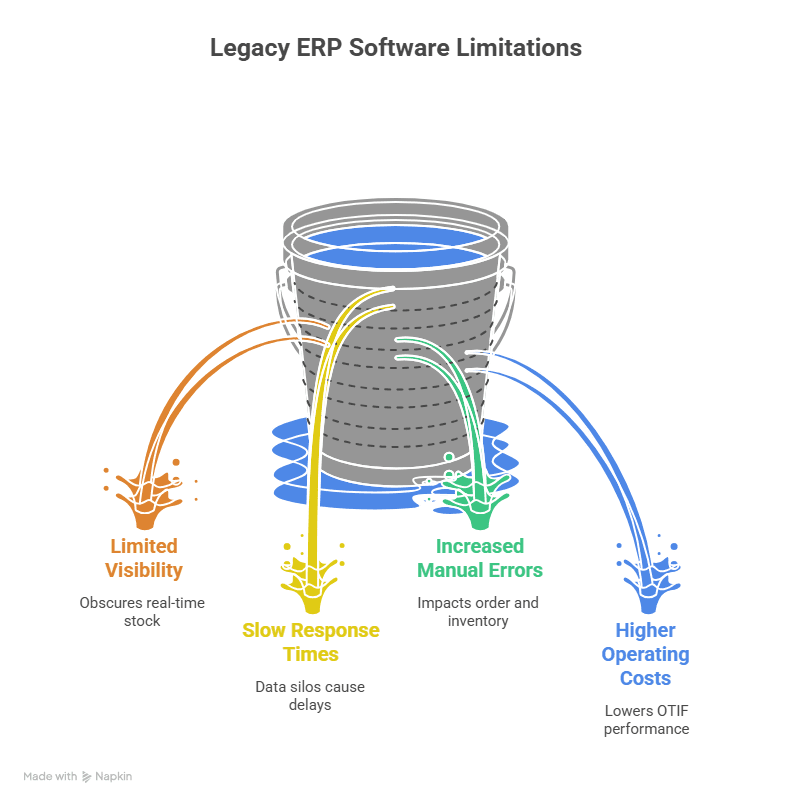
Legacy ERP software does have limitations, like,
- Limited real-time visibility into stock and shipments
- Slow response times due to data silos
- Increased manual errors in order and inventory management
- Higher operating costs and lower OTIF (On-Time-In-Full) performance
These limitations result in higher operational costs. In fact, Gartner predicts the total IT spending for businesses to reach $332 billion by 2028. A modern supply chain ERP software can help reduce operational costs.
Such a system helps integrate all the critical operations, procurement, warehousing, logistics, and accounting. Plus, modern ERP software offers real-time data synchronizations. Odoo and SAP Business One offer features such as demand forecasting, predictive insights, and enhanced planning efficiency.
While both the ERP software do offer many advanced features, it’s essential to understand the difference between them. This enables businesses to select the best option for their operations easily. So if you are a logistics company looking to find the best ERP software, comparing Odoo vs SAP Business One is important.
Odoo vs. SAP Business One: Which One to Choose For Your Operations?
Here is a comparison of Odoo ERP software and SAP Business One for your business.
| Feature | Odoo ERP | SAP Business One |
| Deployment Model | Cloud / On-Premise / Hybrid | Primarily On-Premise (Cloud optional via partners) |
| Customization | Highly flexible and modular (open-source) | Limited customization; partner-dependent |
| User Interface | Intuitive, modern, mobile-friendly | Traditional UI requires training |
| Integration Ecosystem | 40+ official modules, 20,000+ community apps | Limited to SAP and certified partners |
| Target Business Segment | SMEs to Large Enterprises | Small to Mid-sized Enterprises |
| Cost | Lower TCO with modular pricing | High upfront licensing and maintenance costs |
| Implementation Speed | Faster with agile configuration | Longer, multi-phase rollout |
| Support Model | Global Odoo partners, open community | SAP-certified consultants and vendors |
1. Flexibility and Customization
One of the defining differences between Odoo and SAP Business One is flexibility.
Odoo ERP, being open-source, allows deep customization across every business process from warehouse workflows and procurement rules to freight billing and inventory automation.
Odoo’s modular architecture enables supply chain businesses to deploy only what they need and scale as their business grows. In contrast, SAP Business One requires extensive consultant involvement for customization, making even small process changes time-consuming and costly.
| Verdict: Odoo wins on flexibility, offering faster customization with lower implementation costs. |
2. Cost and Total Cost of Ownership (TCO)
Cost is often the deciding factor for mid-market ERP adoption. Odoo’s open-source foundation and modular subscription model make it more affordable, especially for mid-sized logistics firms. The Odoo Enterprise features provide premium capabilities such as real-time analytics, API integrations, and mobile access at a fraction of the cost of SAP’s licensing.
SAP Business One, on the other hand, involves higher upfront costs due to license fees, implementation consulting, and annual maintenance. Customization often adds additional cost layers over time.
| Verdict: Odoo delivers a stronger cost-to-benefit ratio and shorter payback period. |
3. Supply Chain-Specific Capabilities
Both Odoo and SAP Business One cater to supply chain operations, but their depth of functionality differs. Odoo ERP offers advanced modules such as:
- Warehouse management with barcode and batch tracking
- Logistics and fleet management for route optimization
- Procurement automation with demand forecasting
- Integrated accounting and landed cost handling
- IoT and API integrations for real-time visibility
SAP Business One offers robust financial and inventory management capabilities, but it lacks agility in warehouse automation, carrier integration, and multi-warehouse orchestration.
| Verdict: Odoo offers more comprehensive supply chain ERP capabilities suited for mid-sized logistics companies. |
4. User Experience and Accessibility
Modern supply chain operations require user-friendly interfaces and mobile accessibility to support seamless operations. Odoo’s modern UI simplifies daily operations, and teams can access dashboards, scan barcodes, and manage shipments from any device. SAP Business One has a more traditional layout with a steeper learning curve, especially for non-technical staff.
| Verdict: Odoo’s intuitive, mobile-ready interface reduces training time and improves adoption. |
5. Integration and Ecosystem
Odoo’s open-source ecosystem is one of its most substantial advantages. With over 20,000+ community-built apps, companies can extend functionality with minimal dependency on external vendors. SAP Business One, while robust, offers a more closed ecosystem; integrations must go through SAP-certified partners, which increases costs and dependency.
| Verdict: Odoo’s open ecosystem and community-driven extensions make it far more scalable and cost-effective for mid-market firms. |
6. Scalability and Performance
As logistics networks expand, scalability becomes crucial. Odoo ERP can scale horizontally by adding new warehouses, users, or modules without requiring complex reconfigurations. Its modular design ensures that businesses can grow incrementally. SAP Business One can handle scaling, but it often involves infrastructure upgrades and consultant-led configurations.
| Verdict: Odoo’s modular scalability suits growing logistics firms looking for future-ready ERP platforms. |
7. Support, Upgrades, and Maintenance
Odoo Enterprise users receive regular updates, security patches, and version upgrades through Odoo S.A. or certified partners. Its global community also ensures faster troubleshooting and lower dependency on vendor lock-in. SAP Business One upgrades typically require structured version releases, which can sometimes disrupt ongoing operations during major updates.
| Verdict: Odoo offers more agile updates and broader access to support compared to SAP’s tightly controlled maintenance cycles. |
8. Implementation Timeline and Risk
Odoo’s agile deployment approach enables phased implementation, starting with core modules and expanding over time. Many logistics companies complete rollout in under 90 days. SAP Business One implementations typically extend over 6–12 months, involving multiple consultants, various configuration layers, and multiple training cycles.
| Verdict: Odoo’s rapid implementation and lower risk make it ideal for mid-sized supply chain businesses seeking faster ROI. |
ERP Software Selection Criteria for Supply Chain Businesses
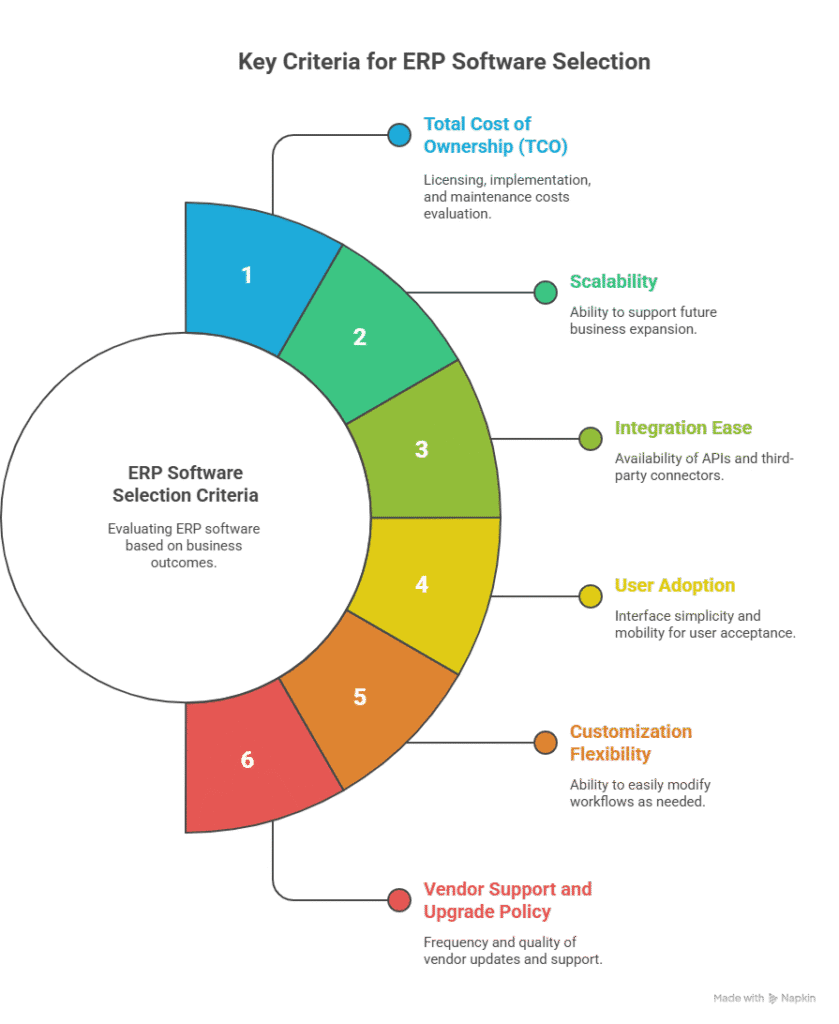
Comparing Odoo and SAP Business One requires an evaluation based on measurable business outcomes. Here are key ERP selection criteria to consider:
- Total Cost of Ownership (TCO) – Licensing + implementation + maintenance
- Scalability – Ability to support future expansion
- Integration Ease – APIs and third-party connector availability
- User Adoption – Interface simplicity and mobility
- Customization Flexibility – Ability to modify workflows easily
- Vendor Support and Upgrade Policy – Frequency and quality of updates
Companies that align their ERP selection with these criteria report up to 35% faster ROI realization post-implementation.
Final Verdict: Odoo vs SAP Business One
When it comes to mid-market ERP systems for supply chain management, both Odoo and SAP Business One are capable, but their strategic fit differs. For mid-sized supply chain businesses, Odoo ERP provides a superior balance of flexibility, cost efficiency, and scalability. It empowers logistics teams with real-time visibility, automation, and agility without the financial overhead of SAP.
SAP Business One remains a solid option for companies already embedded within the SAP ecosystem. Still, for those seeking an adaptable, modern, and data-driven supply chain ERP, Odoo stands as the clear winner. Both ERP software have specific use cases. However, if you are looking for a more advanced integration, especially one that integrates artificial intelligence systems, Odoo ERP is the best option.
However, before investing in Odoo ERP solutions, it is essential to have a reliable partner. INTECH, with a team of Odoo-certified experts, can help you customize the modules and create more innovative logistics systems. Contact our experts now for customized Odoo ERP solutions.
FAQs
1. Is Odoo ERP suitable for growing mid-sized supply chain companies?
Yes, Odoo’s modular and scalable structure makes it ideal for growing logistics and supply chain firms looking for long-term flexibility and cost efficiency.
2. Which ERP offers faster ROI—Odoo or SAP Business One?
Odoo typically delivers ROI within 6–9 months post-implementation, while SAP Business One can take over a year due to higher implementation and maintenance costs.
3. Does Odoo integrate with SAP or other legacy systems?
Yes, Odoo supports API-based integration with legacy ERP systems, ensuring a smooth data migration and seamless hybrid operations during the transition.
4. Which ERP offers better supply chain visibility?
Odoo provides real-time inventory tracking, WMS automation, and logistics dashboards, offering broader visibility compared to SAP Business One’s limited modules.
5. How does the Odoo Enterprise version differ from SAP Business One?
Odoo Enterprise offers advanced modules, including IoT, advanced analytics, and mobile ERP access, at a lower cost, whereas SAP Business One requires multiple add-ons for similar capabilities.
