

Ports and terminals in the current era of globalization are facing an overload in container processing. Take an example of the port processing data of Los Angeles in July of 2025. Total loaded imports were 543,728 TEUs, representing an 8% increase over the previous year.
This clearly shows how there is an overload on ports, and for a terminal operator or a logistics company like yours, it can get complex. Fortunately, the modern terminal operating systems offer capabilities that can help you overcome such complexities.
A modern terminal operating system allows you to manage operations with real-time data insights and alerts. Plus, it helps ensure optimal freight management and automates vital tasks for port operations. However, the question that many logistics companies have is also a legitimate one. Like, what are these next-generation terminal operating systems? How do they optimize operations? What are the features it offers?
This is your guide to modern terminal operating systems. It covers everything from comparison of cloud terminal operating systems vs on-premises setup, core functions, and features. So, without wasting much time, let’s start with the basics first.
What Is a Next-Generation Terminal Operating System (TOS)?
Modern terminal operation systems (TOS) are advanced software platforms that help you manage and optimize operations. Unlike rigid, conventional, on-premise legacy solutions, a next-gen TOS is a dynamic, flexible software platform. Modern TOS is designed to address the complexities of terminal management in today’s fast-paced markets.
It moves beyond basic record-keeping to become an active tool for optimization and real-time decision-making. A modern TOS integrates advanced technologies like Artificial Intelligence (AI), machine learning, and cloud computing.
It provides a single, unified view of your entire operation, breaking down data silos and empowering your team with actionable insights. Another key factor is what type of TOS to choose. Especially when comparing on-premise vs. cloud TOS, it needs to be done according to your business requirements, and then one can be selected.
Cloud TOS vs On-Premise TOS Implementations
Cloud TOS systems offer better operational efficiency compared to on-premise TOS systems. Plus, the pay-as-you-go model of cloud-based infrastructure makes the entire operation cost-effective. Other key differences are,
| Dimension | Cloud TOS | On-Premise TOS |
| Deployment speed | No local infrastructure needed, and you can deploy in weeks | Hardware procurement, racking, and environment setup take more time, leading to deployment in months. |
| Cost model | Low upfront investment. | Higher costs. |
| Scalability | Auto-scaling capabilities | Capacity fixed by hardware |
| Updates and patches | Continuous updates handled by the vendor. | Scheduled internally |
| Security model | Shared responsibility with strong cloud controls. | Complete control of the stack |
| Customization | Configuration-first with limited profound code changes. | Broad customization with higher upgrade overhead. |
| Integration | Cloud APIs and managed services accelerate links. | Tight coupling to local OT/legacy systems is easier. |
| Compliance | Rapidly adopt provider certifications; map controls. | Direct evidence; bespoke controls and audits. |
Knowing what a next-gen TOS is crucial, but understanding the core functions is key. It helps you understand specific use cases for your terminal operations where modern TOS systems can be deployed.
What are the Core Functions Supporting Terminal Productivity?
A modern TOS drives operational efficiency and ensures your terminal runs like a well-oiled machine. It’s not just about tracking containers. It’s about optimizing every single movement and resource within your facility. Effective terminal management hinges on the system’s ability to coordinate various activities intelligently.
From the moment a cargo vessel is scheduled to the second a truck leaves the gate, the TOS streamlines processes, prevents bottlenecks, and maximizes resource usage.
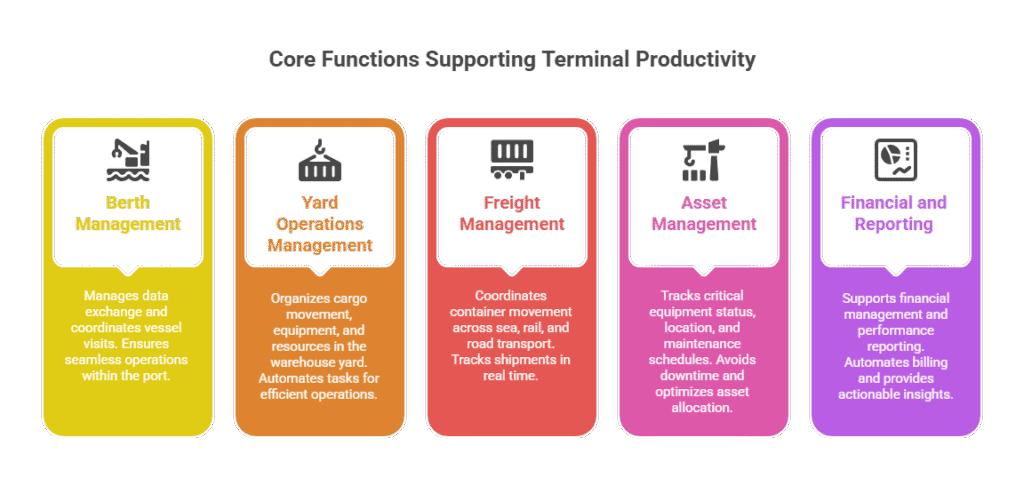
Key functions that directly contribute to improved port productivity include:
1. Berth Management
A key function of any modern TOS is to manage data exchange. In the maritime industry, this exchange happens using the Electronic Data Interchange (EDI) technology. It helps organizations to manage their berth effectively.
This means that you can manage a designated area within the port where cargo vessels load, unload, or undergo repairs. Especially when maritime transport moves more than 80% of goods traded worldwide, effective berth management becomes crucial.
Using a modern terminal operating system, you can ensure effective berth management, ensuring seamless operations. It schedules cargo vessel visits, coordinates their movement between terminals, and provides other services.
2. Yard Operations Management
The yard management function of a modern terminal operating system is all about organizing the movement of cargo, handling equipment, and resources in the warehouse’s yard. Using a cloud-based TOS, you can automate tasks related to yard operations.
It can include,
- Definition of what cargo types and operations will be conducted.
- Allocation and scheduling of the staff for different operations.
- Monitoring the equipment location or a real-time location system.
Plus, a modern terminal operating system helps you plan the load, configure key yard areas, and organize cargo.
3. Freight management
The freight management function of a modern TOS ensures seamless coordination of container movement across various transport modes, including sea, rail, and road. It covers the entire cargo lifecycle from vessel discharge and stacking to gate-out operations by maintaining accurate records, scheduling dispatches, and tracking shipments in real time.
With automated freight planning and integration, the TOS reduces manual documentation, minimizes delays, and ensures regulatory compliance.
4. Asset Management
Efficient asset utilization is vital for maximizing terminal productivity. The asset management function within a TOS tracks all critical equipment, including cranes, trucks, reach stackers, and yard tractors, by monitoring their status, location, and maintenance schedules.
Through real-time visibility, terminals can avoid equipment downtime, allocate assets efficiently based on demand, and plan preventive maintenance effectively.
5. Financial and Reporting
A robust TOS also supports financial management and performance reporting by capturing operational data from every process across the terminal. It automates billing for services such as vessel handling, storage, or gate transactions and integrates seamlessly with enterprise resource planning (ERP).
Advanced reporting tools transform operational and financial data into actionable insights. This enables terminal operators to monitor key performance indicators (KPIs), assess efficiency levels, and make data-driven decisions.
What are the Key Features of Modern Terminal Operating Systems?
When evaluating a new terminal operating system for your enterprise, it’s essential to understand its key features. It is the features that help you achieve operational efficiency. From real-time tracking to automated planning, these features work together to provide complete control over your terminal.
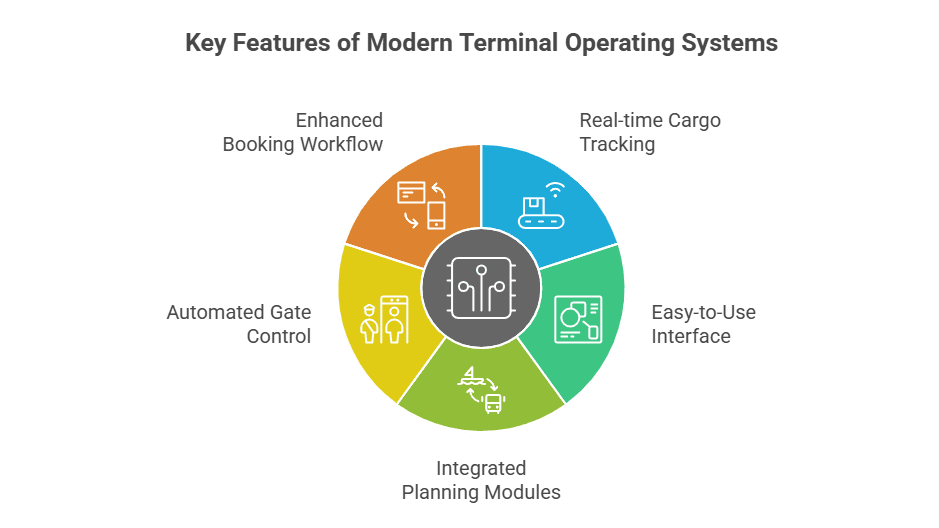
Let’s look at some of the most impactful features you should expect from a modern TOS.
1. Real-time cargo tracking and inventory management
Losing track of a single container can cause delays, reduce terminal productivity, and increase costs. Modern TOS provides precise, real-time cargo tracking and inventory management. It offers the exact location, status, and history of the cargo at all times.
This level of accuracy is achieved by integrating technologies such as RFID and GPS throughout the terminal. Data is transmitted over wireless networks to the central TOS. It ensures that your inventory records are always up to date. This real-time visibility is crucial for efficient asset management and planning.
The benefits of robust cargo tracking and inventory management are substantial:
- Reduced Lost Freight- Minimizes the risk of misplaced containers.
- Faster Retrieval- Allows equipment operators to locate and move containers quickly.
- Accurate Reporting- Provides reliable data for billing and customer communication.
2. Easy to Use Interface
Teams across your terminal automation operations should be able to use the TOS easily because a technically sound system offers optimal results only when it’s handled well by the team.
Imagine dock workers, cargo shipment supervisors, and loading dock operators dealing with a complex interface. It can easily lead to operational hassles and delays.
When selecting a TOS system for your enterprise or small business, ensure that it features an intuitive and easy-to-use interface.
3. Integrated berth and yard planning modules
Effective berth planning and yard management are two of the most critical aspects of terminal operations. In a modern TOS, these functions are not separate silos but an integrated function.
When a shipment is about to arrive, the entire berth and yard where the cargo will be docked are planned using a TOS. It can allocate space for incoming containers, position equipment for unloading, and plan the most efficient stacking strategy.
4. Automated gate and access control features
Gate congestion is a major source of inefficiency for many terminals. An automated gate and access control system helps you ensure better terminal productivity.
Using technologies like OCR cameras, the system can automatically verify appointments and grant access to cargo. Drivers can use self-service kiosks to minimize wait times and reduce the need for manual intervention. This data is added directly into the TOS, providing real-time updates on truck movements.
The modern terminal operating system ensures compliance with security standards, such as the ISPS Code, for your enterprise.
5. Enhanced booking workflow
Booking the container orders requires a unified system. With the booking operations often being fragmented, you need to make sure there is no,
- Duplication of work
- Disconnected planning
- Overload due to unplanned bookings
Modern TOS offers a centralized booking flow for your container operations. Such systems provide specialized booking modules that offer full cycle management capabilities.
How Does INTECH Help you With the Modern Terminal Operating System?
Modern terminal operations and port management requirements are changing. The same old manual processes can’t keep up with the rising demand of supply chain and logistics businesses. Especially with the global trade routes being complex and delays getting frequent, you need a modern terminal operating system. It can help you streamline all the operations, automate tasks leveraging technologies like AI, and ensure optimal efficiency.
However, you need a TOS that can integrate easily with your existing systems and infrastructure. Strategically designed modern terminal operating systems can transform operational capabilities. This is where INTECH, an experienced provider of ports and terminal solutions and an expert in ERP systems, can help. We offer scalable and AI-based TOS that ensure optimal berth and yard management. Contact us now to consult with our experts.
FAQs
What is a Terminal Operating System (TOS), and why do ports need one in 2025?
A Terminal Operating System (TOS) is advanced software that manages and optimizes all port operations, from berth planning and yard management to gate control and freight tracking. Ports need modern TOS in 2025 to handle massive container volume increases.
What’s the typical deployment timeline for a cloud TOS vs an on-premise TOS?
Cloud TOS can be deployed in weeks, as it requires no local infrastructure, hardware procurement, or complex environment setup, allowing for rapid go-live. On-premise TOS takes months to deploy because it requires hardware procurement, physical racking, and setup in a data center.
What APIs and integrations should a modern TOS support?
Modern TOS should support EDI (Electronic Data Interchange), RESTful APIs, and integrations with ERP systems for financial management. Critical integrations also include OCR/RFID systems for automated gate control, vessel planning systems, customs platforms, and Terminal Operating Portals.
What is real-time cargo tracking?
Real-time cargo tracking provides the exact location, status, and movement history of every container within the terminal at any given moment, eliminating lost freight and enabling faster retrieval.
What’s the cost difference between cloud TOS and on-premise TOS implementations?
Cloud TOS uses a pay-as-you-go model, eliminating upfront expenses for servers and IT infrastructure while providing predictable operational costs. In contrast, on-premise TOS requires significant initial investment in hardware, software, and IT staff, leading to a much higher total cost of ownership over time.
